An artefact is not defined by age.
Age records survival. It does not automatically confer meaning. Some objects endure for centuries yet remain ordinary. Others acquire weight the moment they are made.
What distinguishes an artefact is not time alone, but anchoring.
An artefact belongs to a cultural structure larger than itself. It carries the imprint of the world that produced it - its beliefs, materials, hierarchies, and rhythms of life.
Historically, most objects were never intended to be admired at a distance. They existed within systems of use. They were held, lit, worn, carried, or installed within ritual and domestic frameworks. Their authority came from participation rather than display.
A carved doorway did not exist as sculpture. It marked the transition between spaces. A metal lamp did not exist as décor. It organised time through flame. A textile did not exist as aesthetic surface. It signalled geography, community, and status.
Objects were not isolated expressions. They were embedded within living structures.
When those structures fade, the objects remain. Detached from their original context, they begin to circulate differently - entering collections, archives, and auctions. Their rarity is no longer derived from function but from survival.
In that transition, we begin to call them artefacts.
The term often suggests antiquity, yet antiquity is secondary.
What defines an artefact is density - of intention, of labour, of cultural logic.
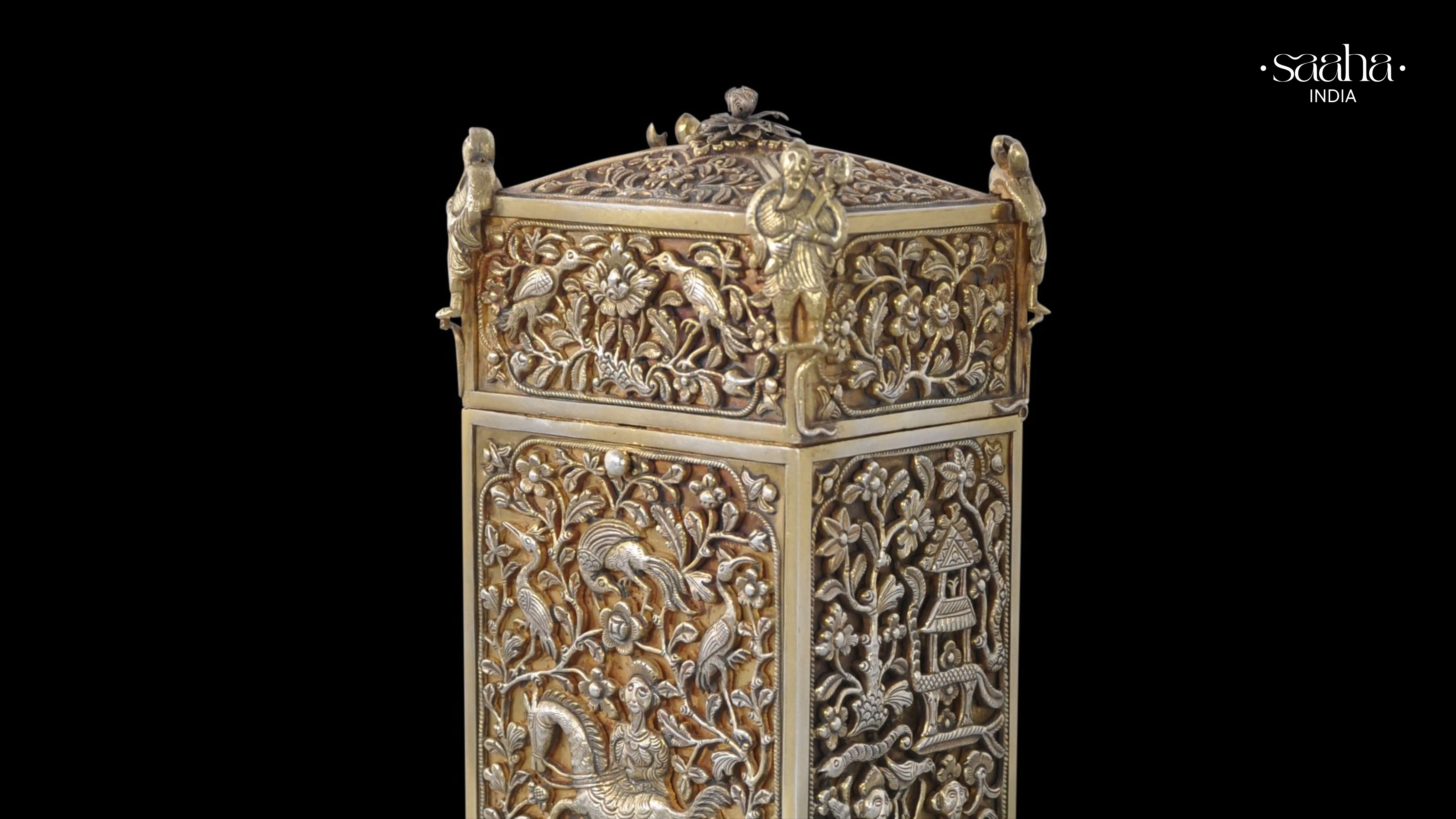
An artefact contains embedded knowledge. It reveals how materials were understood, what forms carried meaning, and what communities valued enough to stabilise through repetition.
Reproducing the surface of an antique does not recreate this density. A faithful copy may mirror proportions or ornament, yet without the context that once animated it, the object risks becoming an echo.
At Saaha, our interest lies not in replication but in understanding the deeper structures that gave historical objects their authority. We study proportion, weight, and material behaviour. We look at how repetition created familiarity, how form signalled hierarchy, and how craft techniques evolved to sustain these decisions.
The aim is not nostalgia. It is continuity.
A contemporary artefact must belong fully to its own moment while remaining aware of lineage. It must acknowledge that it exists within different economic and cultural conditions, yet resist the temptation to detach entirely from inherited vocabularies.
This position sits between imitation and rupture.
Objects made today can still carry artefactual weight when they are constructed with depth - when material intelligence is intentional, references are studied rather than borrowed, and the processes of making respect the skill that sustains them.
Such objects do not pretend to belong to another century. They do not disguise their moment. They stand firmly within it, while remaining in conversation with what came before.
Hence, becomes an artefact.