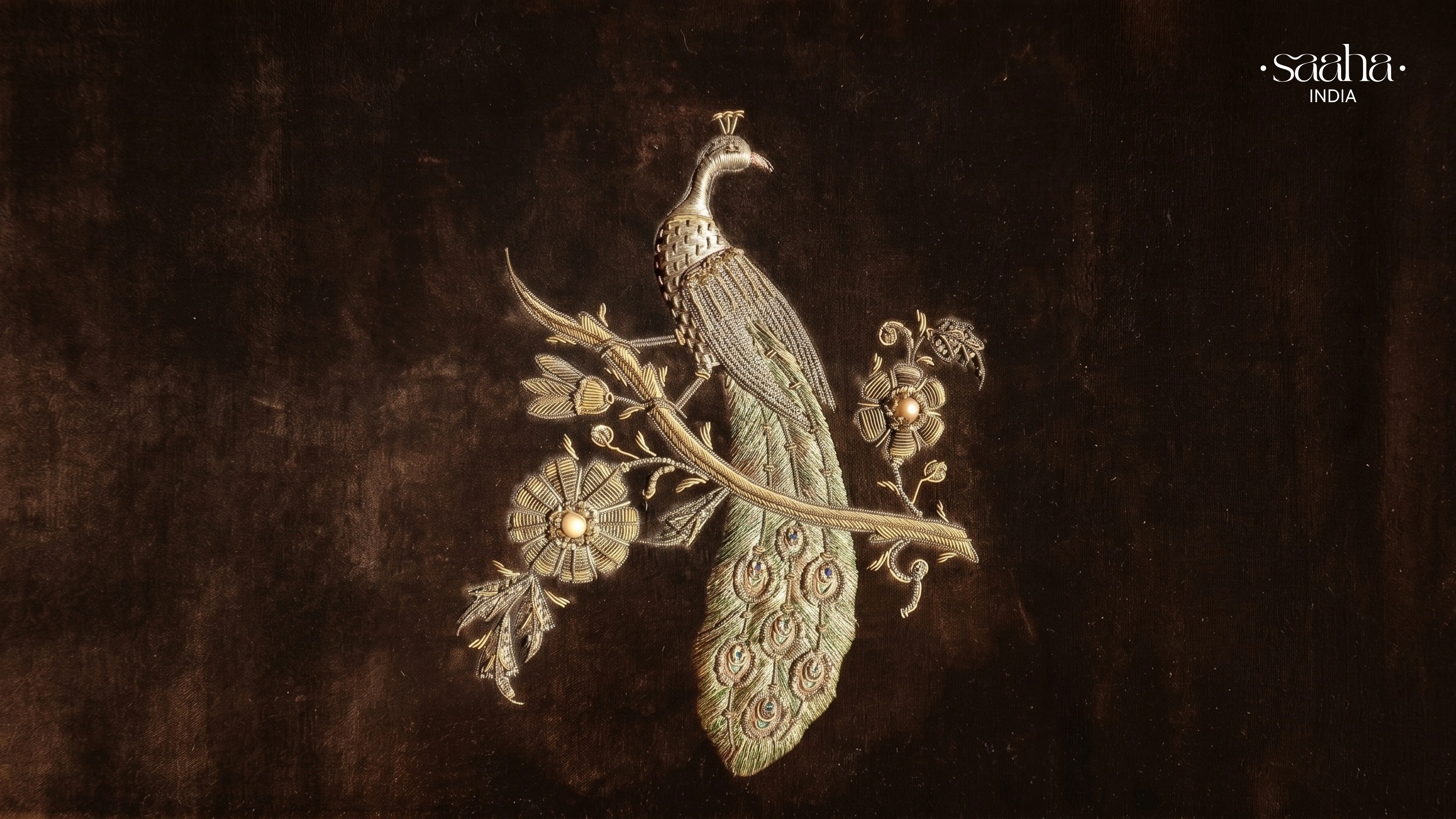
The needle enters the fabric 1,200 times per hour. This is not a guess - this is what Usman Khan told me, unprompted, as though he wanted me to understand before I understood anything else. 1,200 times per hour. He has been doing this for twenty-two years.
Zardozi is Mughal court embroidery. The name comes from Persian - zar means gold, dozi means stitching. It entered India with the Mughal court and became, over two centuries, something India made better than anywhere else on earth. The Mughal emperors wore it. The nobility wore it. The craft employed thousands of craftsmen across the empire. And then the empire collapsed, the court patronage evaporated, and zardozi - without the infrastructure of power that had sustained it - nearly didn't survive the 20th century.
By the 1980s, there were serious concerns among textile historians that the craft was hollowing out. Not disappearing - diluting. The artisans were still there, but they were being asked to work faster, with cheaper materials, on things that needed to look like zardozi rather than be zardozi. Synthetic threads instead of real gold. Shortcuts in the backing. Designs that required less skill. The market wanted the surface of the thing without paying for the depth of it.
Usman Khan's father refused. This is the detail Usman mentions without drama, almost as a given: his father turned down work he considered beneath the craft. They were not wealthy.
This was not easy. But there is a tradition in certain artisan families - call it pride, call it stubbornness, call it the understanding that if you compromise the work, eventually the work ceases to be anything worth doing - that treats craft standards as non-negotiable.
Usman inherited the needle and the position.
The Karma Kshetra Chaupad - Saaha's game board rooted in the Mahabharata - needed embroidery that could carry the weight of a story about fate, consequence, and the battlefield of choices. That's not a brief you can outsource to someone who is going fast.
The gold thread Usman used is real gold - metal wound around a silk core. It cannot be pushed through fabric. It sits on the surface, couched down by a finer thread that passes through. Every motif - every symbol from the Mahabharata that lives on the board - required him to decide, stitch by stitch, where the light would fall, how the gold would catch it, what the eye would follow.
He worked on the Chaupad for eleven weeks. The board is the size of a dining table. 1,200 stitches per hour, for eleven weeks.
I asked him what he thinks about while he works. Another long pause.
'I think about the thread,' he said. 'Where it wants to go.'
This is what it sounds like when craft knowledge stops being technique and becomes something closer to conversation. He is not imposing his design on the fabric. He is in dialogue with it. 1,200 times per hour, for twenty-two years, he has been learning to listen.