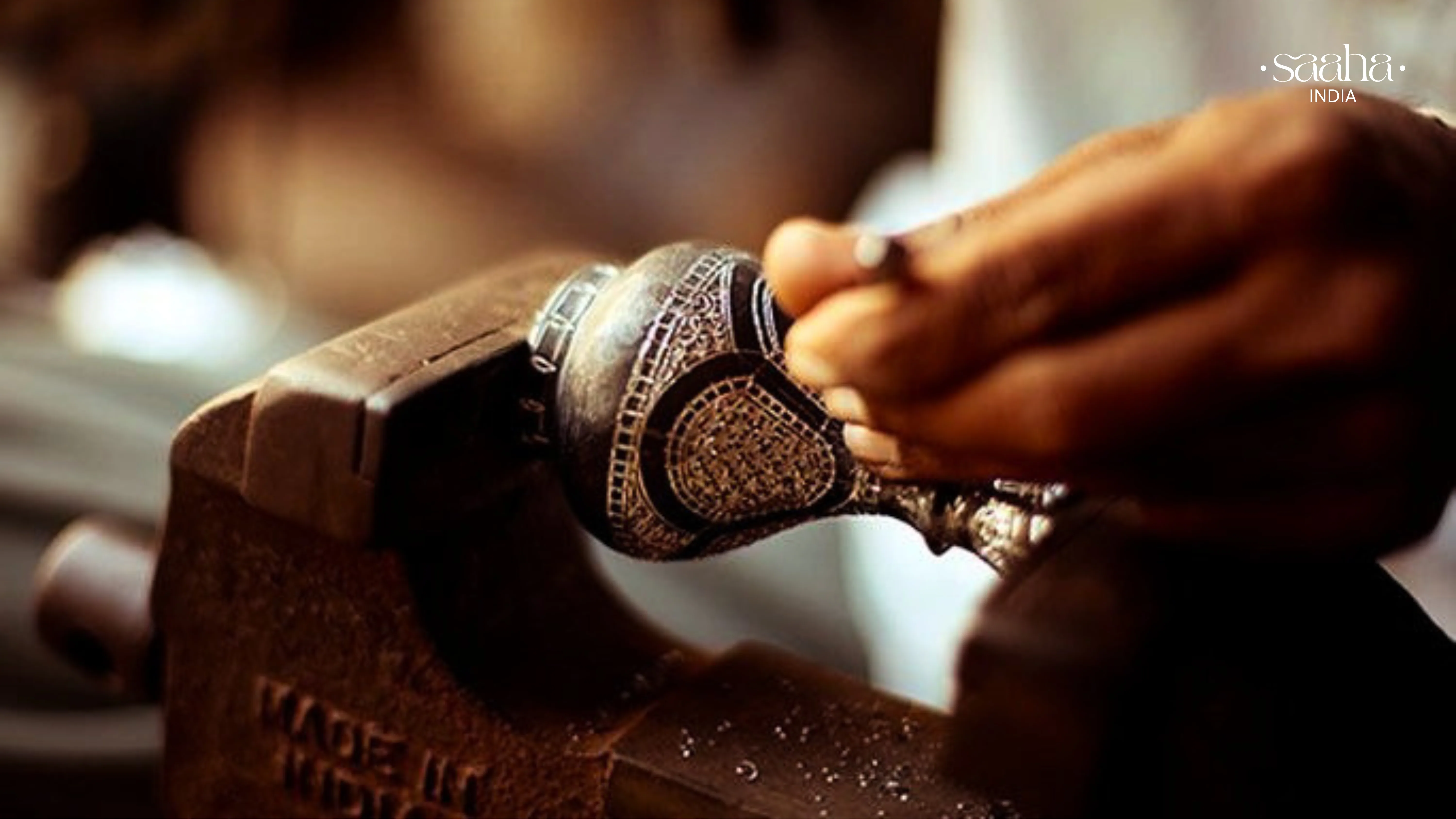
Ratan Lal does not have a studio. He has a shed. And in that shed, which smells of wax and something older than wax, he is doing something that has not changed in three thousand years.
Lost wax casting - dhokra, or cire perdue if you want the French term that somehow became the international one - is a process so simple in theory and so unforgiving in practice that it hasn't been improved upon since the Bronze Age. You make your object in wax. You encase it in clay. You heat the clay until the wax melts and runs out through channels you've built in - that's the 'lost' part. Then you pour molten metal in. When it cools, you break the clay. Inside is your object, now in metal. You cannot undo this moment. Whatever the wax was, the metal becomes.
This is where Ratan Lal's hands become the point.
The wax he uses is mixed - beeswax, resin, mustard oil, in proportions he will not tell me precisely. He has been making this mixture for thirty years. His father made it. His grandfather. The clay mixture is similarly private. The temperatures he uses - the heat of the kiln, the temperature of the metal at pour - he knows by sight and smell, not by instrument.
This is not mysticism. This is calibration that took generations to develop, cannot be written down accurately enough to be useful, and therefore lives only in the bodies of people who have done it ten thousand times. When Ratan Lal says the metal is ready, it is ready. There is no thermometer in this shed.
For the Marudhar Walking Stick - Saaha's artefact rooted in the desert crossing of Hameer Khan and his camel Bhairav - Ratan Lal cast the brass eagle that sits at the handle. The brief asked for a bird that looked like it had weight, like it had seen something. Not decorative. Not proud. Watchful.
He made seven wax models before he was satisfied. Six of them, he says, were eagles. The seventh was a bird that had been somewhere.
The pour is fast. Maybe four seconds. Whatever happens in those four seconds - if the clay cracked in a way you missed, if the metal cooled too fast, if there's an air pocket in the channel - you find out when you break the mould. You can't look inside. You cannot stop it midway.
Ratan Lal has been doing this for thirty years and he still goes quiet in the seconds before the break. I asked him if it gets easier. He considered this for a while.
'The metal always surprises me,' he said. 'Sometimes better than I expected. Sometimes not. I am never sure until I see it.'
The eagle that came out of his mould that day is the eagle on the walking stick. It looked, as briefed, like it had been somewhere. The six earlier wax models are gone - they were the wax that had to be lost before the right version could be found.
Three thousand years of technique, in a shed that smells of beeswax, operated by a man who reads temperature by smell. That's where the Marudhar Walking Stick came from.