I want to tell you about the moment I understood what had been lost.
I was standing in a haveli in Mandawa - this was maybe four years before Saaha existed, when I was still just a person with an antique store and a feeling I couldn't quite name. The walls of this haveli were covered, floor to ceiling, with paintings. Not decorative paintings. Paintings that told stories - mythological, historical, domestic. Paintings by someone who understood anatomy, perspective, narrative, colour theory. Someone who had spent years learning to do this. Someone with a point of view.
I asked whose haveli it was. I was given the name of the merchant family that commissioned it.
I asked who painted it. And there was a pause - the kind of pause that tells you a question hasn't really been asked before - and then: 'Artisans. Local artists.' No name. No family. No record. The painters of this extraordinary work had vanished completely from the story of their own work.
I stood there for a long time. And something shifted.
In European art history, the master's signature is everything. Provenance, attribution, the careful reconstruction of who made what - these are entire scholarly industries. We know the names of Italian fresco painters who worked in the 14th century. We have their letters, their contracts, their self-portraits.
India made things of equivalent or greater beauty, and in most cases we have no idea who made them. Not because the records were lost. Because the records were never kept. The object was the point. The maker was incidental. This was not, I think, contempt for the artisan - it was something stranger, more philosophical. A belief, perhaps, that the ego of the maker should dissolve into the work.
It's a beautiful idea. It also means that five thousand years of skilled human beings left no trace of themselves in the civilisation they built with their hands.
That is an enormous loss. Not just for history. For the artisans who are alive right now, working in traditions they inherited, making things of astonishing skill - and still not being named.
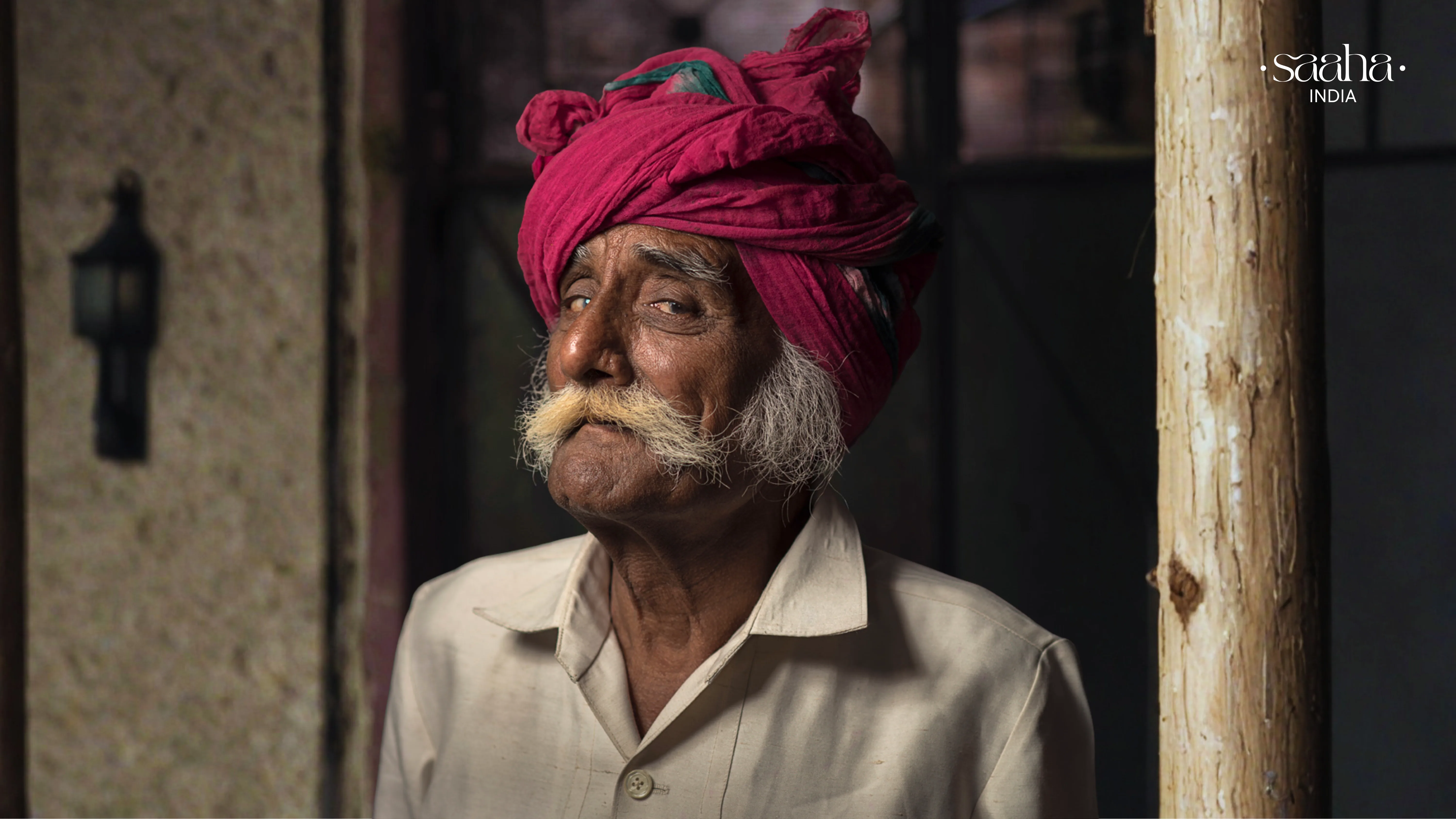
Every artefact we make at Saaha india is signed. By the artisans who made it. Their name is on the object, in the documentation, in everything we publish about the work. This is not a marketing decision. It is a correction. A small one, against a very large historical wrong.
When Ratan Lal signs the Marudhar Walking Stick, he is doing something his grandfather never got to do. When Usman Khan's name is on the Karma Kshetra Chaupad, it is the first time, in a very long lineage of nameless makers, that someone said: this hand made this thing, and that hand has a name, and the name matters.
I don't know if it's enough. But I know it's necessary. And I know that the haveli in Mandawa - those extraordinary walls - deserved better than anonymity.
We are trying to make sure the next five thousand years look different.
- Jaishree